Sam Altman just thanked software engineers for getting us here. For engineers navigating an uncertain market, it hit differently. But the future we helped build is more promising than ever.
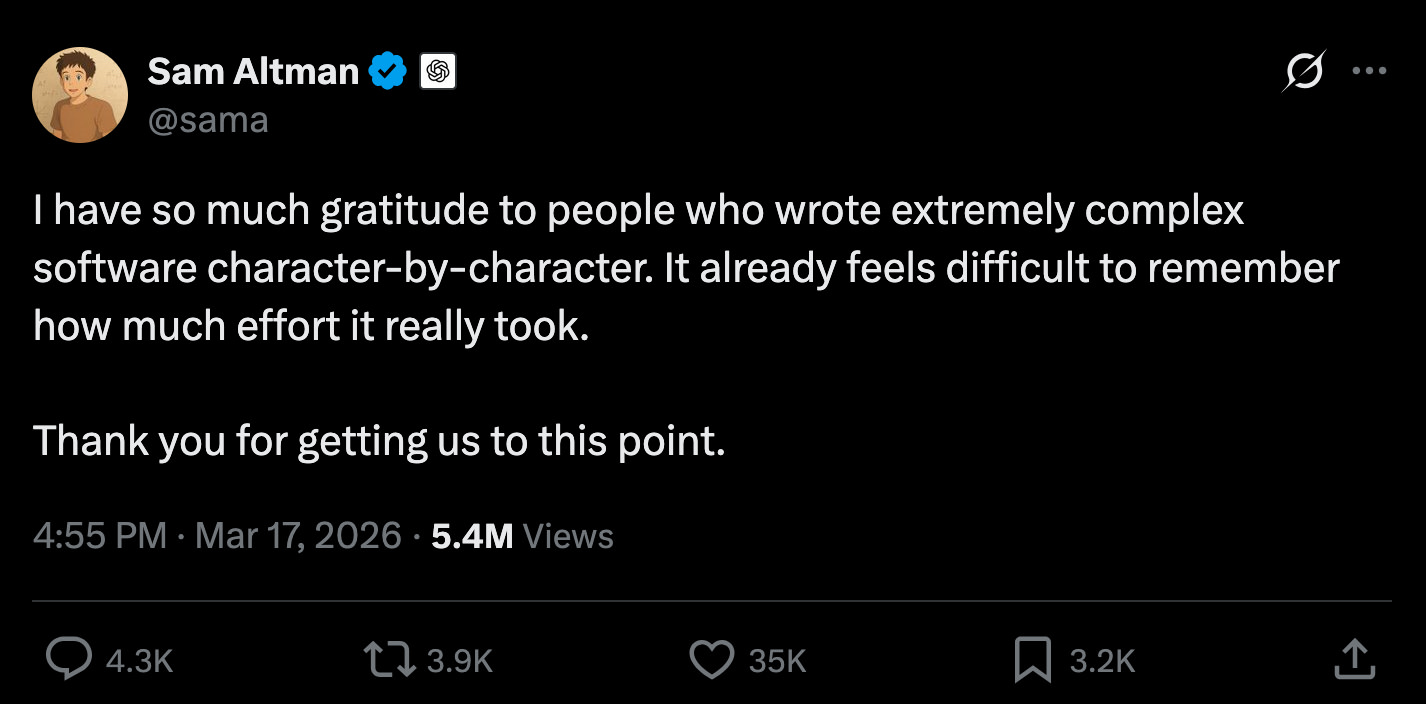
The replies split fast. Some found it moving. Many found it tone-deaf. A few called it a eulogy. The reaction was understandable — a lot of people in this industry are navigating real uncertainty right now, and a thank-you from the CEO most associated with that disruption lands differently depending on where you're standing.
I've been integrating LLMs in production for over two years. Nothing moved as fast as LLMs did in the last twelve months, nor reshaped the industry as deeply. Getting this right matters for anyone building software in 2026.
What actually changed
Writing complex software character-by-character was genuinely hard. It required years of accumulated pattern recognition, the kind of intuition that only comes from debugging things that shouldn't have broken in the first place, and a tolerance for holding enormous complexity in your head simultaneously. That scarcity was real and the tribute is fair.
AI has meaningfully changed that. Code that used to take a senior engineer a day can now be drafted in minutes. Boilerplate, tests, documentation, routine refactoring: entire categories of work that consumed significant professional time are largely automated now. Nearly half of all code written in 2025 was AI-generated. That's the data.
The "thank you" lands correctly as a historical observation. The question is what it misses about the present — and what it says about what comes next.
Scarcity shifted. It didn't disappear.
What changed is where the bottleneck lives. Code production was the constraint. Now the constraint is something harder to automate: deciding what to build, how to architect it at scale, and — crucially — knowing when the AI output in front of you is confidently wrong.
That last one deserves more attention than it gets. AI-generated code is fluent, fast, and frequently incorrect in ways that aren't immediately visible. It doesn't know your system. It doesn't know which components are load-bearing. It doesn't know that the elegant solution it just proposed will break under the exact load conditions your system faces in production. What AI removed is friction, not responsibility. Poor decisions now move faster, spread wider, and fail louder than before.
The real bottleneck has moved from execution to judgment.
AI amplifies whatever judgment it's given. With weak judgment, it produces fast, confident chaos. With strong judgment, it becomes a force multiplier.
The role didn't disappear — it moved up a layer
The engineer of 2026 spends less time writing foundational code and more time orchestrating a dynamic portfolio of AI agents, reusable components and external services. The value lies in designing the overarching architecture, defining precise objectives and guardrails for AI counterparts, and rigorously validating output before it touches production.
The skills that become irreplaceable in that context are worth naming: architectural judgment — understanding how thousands of components interact under real conditions, including the ones nobody documented. System integrity — the instinctive awareness that a seemingly small change affects a shared container across multiple features. Risk intuition — identifying the fifty lines that must never be wrong. The ability to turn ambiguous problems into precise solutions before a single line gets written.
Senior engineers realise nearly five times the productivity gains from AI tools compared to junior engineers — precisely because deep fundamentals let you leverage AI as a force multiplier. The abstraction layer went up. The stakes didn't go down.
Amazon just learned this the hard way
Last week, one of the most sophisticated engineering organizations on earth was dealing with the direct consequences of this gap.
Amazon issued a "90-day code safety reset" across critical systems after a series of production incidents with a "high blast radius" — attributed to AI-assisted changes where best practices weren't yet established. In one case, an AI tool deleted and recreated the entire coding environment. Their response: junior and mid-level engineers now require senior sign-off on every AI-assisted change.
Amazon didn't need more code writers. They needed engineers with the judgment to catch what the AI missed — before it reached production. The scarcity didn't vanish. It showed up somewhere else, at a higher cost, with a larger blast radius.
What genuine gratitude could look like
OpenAI was founded in 2015 on a specific promise: that the benefits of this technology would flow to humanity broadly. Open research, shared models, the knowledge built on decades of collective human output returned to the commons that produced it. The name wasn't accidental.
The distance between that founding vision and a $500 billion closed-model corporation is worth sitting with — especially in a week when the CEO is publicly reflecting on what engineers gave to get here. Meta releases Llama and competes effectively. Mistral open-sources and builds a real business. The idea that openness and commercial viability are incompatible has been tested and found wanting.
OpenAI recently released open-weight models for the first time since GPT-2 — not out of principle, but because DeepSeek forced their hand. Sam Altman himself admitted they had been "on the wrong side of history." It’s a start. But open weights without open architecture, training data, or methods isn’t quite the vision from 2015. The direction is right. The distance still matters.
The future of software
The tools available right now are extraordinary. The problems worth solving are getting bigger and more ambitious, not smaller. Engineers who develop the judgment to direct AI effectively — who can define the right constraints before the agents start, catch the failures before they scale, and take ownership of systems that increasingly build themselves — are going to operate at a level of leverage that simply didn't exist three years ago.
Code production was the foundation. What gets built on top of it is the exciting part — and that work has never been more human.
Based on the unprecedented investments recently made into AI — OpenAI alone just raised $110 billion, the largest private funding round in history — has the open-source ship sailed, or is there still a version of this future where the benefits flow more broadly? Where do you land?